Monday, March 27, 2017

May the Juice be with you- the final review

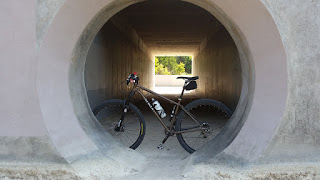
I have been riding my Soma Juice for over two years and I think it's time to say goodbye to this lovely brownstone steed. It's a beautifully designed frame- the hourglass headtube, curve stays, elegant use of sliding dropouts, versatility, durability, and smooth ride have all served me well. I rode this bike primarily off-road, tackling Austin chunk every week, and one gravel race, which turned out to be my favorite gravel race yet.

newborn Juice, January 2015
The above copy sounds like an advertisement because I have been reading bicycle reviews for so long. The brutal truth is that I was working at a bike shop at the time that I purchased this frame and it was literally my only option. I was riding a too-small Surly Karate Monkey, which is also and excellent bicycle frame, and I wanted to ride something longer in terms of reach. After two decades of getting my kicks on a 20" BMX bike, "small" mountain bikes seemed like a good idea to me, so I was riding a frame on which I felt comfortable at first, but time and miles on the trail showed me how squirrely handling can be and how unforgiving on the spine it is.

I wanted a steel 29er that would easily convert to single-speed use and not break the bank. Working in a bicycle shop means you don't make a lot of money and, with other financial priorities in my life besides purchasing bicycle parts, I could not afford to buy much of anything that was not subject to a hefty industry discount. The company for which I was working has recently lost its relationship with Surly, so a new Karate Monkey was out. Due to various levels of corporate nonsense, I was also forbidden to buy anything else from any other bike company with which my employer did not already have a business relationship, so that left me with the option to pay full-price for something from another retailer, or buy a Juice direct from the distributor. I chose the latter.

preparing for Full Moon Fever, a nighttime gravel race, which was canceled due to a steady downpour that turned the dirt roads to rivers.
I was not terribly excited about the Juice at first, feeling compelled by forces beyond my control to ride it over any other choices, but it turned out to be a great choice. I won't pretend that I can tell the subtle qualities of the metal tubes, the artistry of the welds, the "lateral/compliant" magical qualities of a "lively" bicycle that elevated me to mystical planes of existence. No, it's a piece of metal that connects two wheels and various components that translate human movement into locomotion. It does this much better than many other similar pieces of metal and it led to me having a lot of fun and burning a lot of calories in the process to make room for additional cookies that I would not have otherwise eaten.

it's peanut butter jelly time!


In short, the Juice was fun to ride, not very expensive and didn't keep me from doing anything I would not have otherwise done on a different bicycle frame.

At least that's what I tell myself.

a brief experiment with gears instead of single-speed
One thing that never felt entirely comfortable with on the Juice is the "weight" of the front end, which, for me has a lot to do with the chainstay length. Chainstay length on a mountain bike is a touchy subject, but I tend to land in the short camp. All other things equal, having the rear wheel tucked closer to you center of gravity makes it easier to shift your weight far enough behind the rear axle to huck the front wheel up onto or over whatever is in your way. Or just do a wheelie, which is an essential part of having fun on a bicycle.

The Juice is designed such that the sliding dropouts make the effective chainstay length about 445mm or just under 17.5". If you have gears on it, you can slam the sliders to this position and leave them there and this position is sufficient for many people, especially gearies. If you ride single-speed, you have to use the sliding position of the dropouts to tension the chain. With the range of effective chainstay lengths ranging from under 420mm (16.5") to ... much longer, the Juice limit of 445 leaves it on the long end of the spectrum.


Since I ride this bike with a single speed drivetrain most of the time, I have to make compromises, as all singlespeeders do. When the trail is flat and you want to go fast, there's a limit to how fast you can realistically go once you legs top out in RPMs. When the trail gets steep, the terrain loose, or you reach a series of rocky ledges, as often happens where I ride, most riders would shift to an easier gear, stay seated, and spin the cranks with relative leisure. It's still no picnic to spin your way up a hill in a low gear -- it's taxing on your heart and lungs. But with a single speed, you have to stand and "mash" the pedals in order to maintain momentum.

lightweight tires and a hard gear ratio made urban exploration rides fun on rainy days.


When a momentum-killing rock, ledge, patch of loose material, or change in topography presents itself, you have to react quickly, shifting your center of gravity on the bike to lift the front tire, unweight the back tire, or dig into the backside of and obstacle you have just cleared for that extra ounce of momentum. This is where bicycle designers have a conundrum that I don't envy: design a bike that is a compromise between stability and maneuverability. I think the Juice erred on the side of stability.

Climbing a hill on a singlespeed or navigating otherwise tricky terrain means shifting your weight around a lot, more so than you would need to with gears. To increase the amount torque applied to the rear wheel needed to keep going uphill, I need to change my body position so that my legs and piston the pedals up and down with more force. For me, that means standing up and getting forward a bit. Doing so, however, puts more weight on the front wheel and less on the back, increasing the chances of stalling out from a front-end collision or losing traction on the rear wheel and spinning out, thus ending the fun of painfully grinding my way up a ridiculous pitch of earth. If I lean back a bit to get the rear to bite harder, my legs lose some of the wattage I need to put into the pedals and I stall in lieu of ripping my knees apart or the pedals from the cranks. I am not sure which would go first.


What is the answer to this? The peanut gallery is saying "why don't you put gears on your bike, ya big dummy?" No, being stubborn is more fun and gives me writing fodder and another reason to be smug about riding my bike. No, really, the reasons for riding a single speed mountain bike are the subject of another session. The real answer has to do with what I mentioned earlier- is it the bike, or the rider? I think it's some combination of the two.

If I wanted to be able to rocket up and over all the difficult terrain I just described on a singlespeed bike, I could do one of two things:
1. ride more, get a stronger core and legs and arms, increase skill and vision to chose routes across the terrain that make those feats more likely to succeed.
2. change my bike in such a way that it is more conducive to my skills and body proportions for the terrain.

I only have so much time and patience for 1) so I am trying 2). This goes back to what I was saying about frame design and balance. Each rider has a different center of gravity; the amount of effort it takes to shift one's weight to increase traction or unweight the front or rear of the bike is different. Most frame manufacturers only take into account a rider's skeletal proportions so that the contact points of the bike (pedals, saddle, handlebar) fit proportionally for efficient, comfortable pedaling. However, as riders' heights vary, so do their center of gravity. But frame designers typically only change the dimensions of the front end of the bike and not the rear to account for riders sizes.

post-nighttime ride that turned a bit muddy.

For example, a few years ago, I helped a guy build a BMX bike for himself. This bike was designed for jumping, riding ramps, doing tricks, etc. With their small 20" tires, BMX bikes are very easy to toss around, but subtle changes in geometry can make the bike more stable or more "flickable." The trend in BMX bikes are the time was shorter and shorter chainstays. An older bike might have 14.5"-15" stays, especially if it was designed for racing or dirt jumping. At the time, chainstays were dipping well below 14" and pushing 13" to make the bike easier to flip around.

The problem was that this rider was six-and-a-half feet tall. The front end of the bike was designed with an extra-extra long top tube and he put the most enormous handlebar that he could find on it to accommodate his height. But the chainstay length remained true to the trend, extra short. With his height, lifting the front end required only the tiniest shift rearward, whereas a shorter rider would require more effort to do so. The result was that the bike was very unstable, difficult to find a balance point to manual it and easy to loop out and wind up laying on his back. He left the chain long enough that the rear axle was pushed as far back in the slots as was safe, but it still left a lot to be desired in terms of stability.

All this is to say that, while the Juice is a fantastic bike, I wanted something with a shorter chainstay so I can do wheelies on it and manhandle it over difficult terrain. All of my mountain bikes have been steel and rarely have seen gears, and the pool of available steel, 29er, singlespeedable framesets with short chainstays is a fairly short list. Stay tuned as I have already purchased and am now riding a new frame and will report on the new experience.

secret location

Sunday, March 26, 2017

self-filmed video of Austin trails

I spent most of the day filming a video of myself (with a little help from trail guru Carl) and this is the result of many hours filming, editing clips, and cobbling together the footage. Enjoy!


All of the above video is taken within a few miles of trails near my home. I had trouble getting perspective on the terrain. The rather bouncy downhill sections and chunky climbs I am doing here look much more mellow than reality. I thought it was funny to include ten takes on the same climb, which is littered with little ledges and fat roots, only to discover that the angle only makes me look like an idiot who can't ride a bike in a straight line. I will need to work on that so my next video project is more compelling.

Bonus little behind-the-scenes info: I filmed this on my Samsung Galaxy 5s, which I always have on me anyway. I have made some cheesy videos in the past with a smart phone learning on a rock or bungee-corded to a tree. This time around, I went all-out and spent a whopping $13 on a flexible tripod that allowed me to balance and aim the camera exactly where I want it by perching it on a rock, warping around a tree brand, or standing it on the ground.


Filming took all day and I had to stop by the house halfway through to recharge my phone and eat a ridiculous sausage, which is also profiled in the film.

Further bonus info! These will probably be the last images of my riding the Soma Juice frame. It's been a great frame but I am trying something new. A more thorough review of the Juice is coming soon.


Monday, February 6, 2017

waterproof socks

My feet get cold easily. I probably have a medical condition. It's one of the many reasons why I can't imagine moving back to the Midwest, where I grew up. No amount of layers of socks made from cotton, synthetics, wool, baby seal or tauntaun guts (unless said tauntaun is really fresh, like warm saurkraut) can help me. I need an external heat source. The feeling of constantly-numb toes horrifies me so much that I would need to make a heavy investment in foot-warming apparatus before spending any significant amount of time up there again.

The only thing worse than cold feet is cold feet that are also wet. Since most of the cold water on might encounter while riding a bicycle is on the ground, it makes sense that keeping your feet dry would be important. Enter Dexshell socks. There are a few other makers of waterproof socks on the market but these are a little cheaper than the others and I got a pair for Christmas this year. I finally had the opportunity to put them to the test this weekend.

I joined some friends for an urban ramble on a foul Texas "winter" day of overcast skies, drizzily atmostphere, and frigid sub-50 temperatures! OK, it was not that cold, but cool enough to make getting wet miserable. We had planned to ride from a friend's east-side home to a park on the north side from town, then south through the city and back over to the house. I had time to do about half of that and learned that a rigid 29er with fat knobbies is not the worst road bike choice after all.

At one point, we made a point of going off-road, despite the soggy conditions and the fact that none of us was riding a bona fide mountain bike. We abandoned the world of pavement as soon as we could and followed a jeep road for a while, hoping it would eventually lead us back to civilization. Before we made our way back to pavement, we had to traverse a boggy area that resulted in wet shoes all around. Seeing the water, I realized that, given the misery that cold feet gives me, I would probably be scurrying home once I felt the water sloshing around in my shoes. So I took the plunge.

Cold? Yes! But dry. Dexshell socks held up to this first test. I learned that my toe covers and my shoes hold water well, and that cold water surrounding my feet for the next few hours certainly was not fun, but much better than being wet.

We kept riding and at one point I peeled off to head home. I stayed dry for most of the rest of the trip and lost feeling in my toes, as was expected. I learned that wet shoes are still cold shoes, so if you really want to keep feeling your toes, you need more than waterproof socks, but the socks are a good start.
[followed this concrete wall for a part of my journey. good message!]


Texas Chainring Massacre report

Half of the fun of mountain biking, for me at least, is exploring and just pedaling for as long as I can be out before life's obligations call me back. The other half is about technical challenges. Sometimes I want to focus on the latter, and I can find plenty of nearby trails to challenge me in that regard. The best way to do the former is a gravel grinder, a popular race/fun ride format that involves riding long courses on unpaved, rural roads.

I have done a few of these over the years, including The Holy Roller, Castelle Grind, and the Texas Chainring Massacre. Previously, I have ridden cyclocross-type bikes that I have owned (Pake C'mute, Salsa Vaya, Soma Double Cross Disc) and, while those bikes have been great for this kind of riding with 32-42mm knobby tires, I took the plunge a few months ago and sold my last CX bike and committed to making my Soma Juice hardtail 29er my only bike. With a little bit of adapting, a mountain bike makes a great gravel grinder. Most of the hundreds of other people riding around me (and past me!) were riding cyclcross/gravel-specific bikes for good reason, but I just wanted to do this for fun and finish these events strong with my bike.

In addition to riding what many will consider a sub-optimal bike for a gravel race, I chose to try this last event, the 2017 Texas Chainring Massacre 100k on a single-speed bike. To make my bike gravel-ready, I had to change a few things from my usual trail setup:


*replaced the 120mm suspension fork with a rigid Salsa Chromoto Grande fork. This fork has a tapered steerer tube like my squish fork, and a 15mm through axle, so I didn't need to do anything different with my front wheel.


[Salsa rigid fork]

*swapped my 60mm stem and 740mm riser bar for a 100mm stem and 640mm flat bar. I also put some bar ends and TOGS. Since most riders use a bike with a drop handlebar for additional hand positions, I felt that this was the next best thing, and I ended up using 3-4 hand positions over my hours on the road

*gearing- this was a tough call. I live in Austin and the event is held in north Texas. I had ridden CRM two years ago on a geared bike and did not remember the terrain well enough to know how much climbing would be involved. Knowing I would not have the options of shifting gears meant picking a gear that would cruise well on the flat sections and be easy enough to pedal up the hills. I went with a 38t front chainring and an 18t rear in place of the 32/20 combo that I usually use. As a bail-out option, I slid a 20t cog on next to the first cog, so that I could wrap my chain around it without too much drama and hobble to the finish on a slightly easier gear.
[big ol' KMC singlespeed chain actually didn't play nice with my Raceface narrow-wide ring, so I put an old 10-speed chain on instead]

*tires- this is, in my opinion, the thing that can make or break a gravel grind experience. I have ridden these events on 32mm Contintal Race Kings, 42mm Conti Speed Rides, and 35mm WTB Cross Boss tires. Every time I do one of these rides, I start to think "man, I wish I had bigger tires on my bike. next time I'll put some fatties on!"

While the Cross Boss has been my favorite "skinny" tire so far (partially due to the effortless tubeless application), I found a good deal on some Schwalbe Thunderburt tires in a 29x2.1 size and chose those over the Specialized Renegades that were competing for my attention. Thunderburts are light, supple, and fast on hardpack and on pavement, and the casing is big enough to roll at lower pressures. They seated easily on my WTB rims and have been grippy enough for some nimble singletrack riding.


The Chainring Massacre experience was my best gravel race yet. Kevin and the Spinistry team have upped their game this year with a much better-organized event than my last experience. There were hundreds of riders, timing chips, well-marked turns on the course for people riding different distances, and credit for free food/ liquor in the little town square at the end of the ride. The route took us through beautiful, remote farm roads and lots of challenging gravel, rolling hills, and folks willing to spin and chat once the group spread out enough.

As I mentioned, hand position options were a great idea for my mountain bike. I am having a harder and harder time making the case for myself that I should ever own a drop-bar bike again when I can ride narrow flat bars with ends and get the same effect (for my purposes, at least, YMMV). Tires were spectacular, I brought plenty of snacks and water, and I dressed warm enough for the ride that started just about freezing and ended in the low 50s. My toes quickly went numb and stayed that way for the duration of the ride, and I don't recall stopping to pee at any point. Pedaling and drinking water and not peeing for that period of time is probably not healthy.

I managed to finish in just over 5 hours and I was the 200th rider to complete the 100k distance. That is not impressive my any means, but I was riding against at least one Tour de France champion and handicapped myself with a relatively heavy bike with only one gear. I was perfectly pleased with my performance, though. I rode strong the whole time, only stopped once at the lone water station to refill, and didn't walk any of the hills, as much as my legs wanted me to.

Looking back, I would have geared down just a tiny bit to help with the hills (maybe a 19t cog instead of 20t) and shoved some warmers in my shoes to prevent the numbness that plagued me the whole way. Looking forward to next year. Before that, I have Castell, Holy Roller, and whatever urban rambles I can cobble together in the meantime.

[The Juice getting some well-earned R&R]


Wednesday, December 14, 2016

The versatile Soma Juice- gravel mode

As I mentioned in my last entry, I recently sold my Soma Double Cross Disc not because it was not a terrific bike, but because it didn't do anything that my mountain bike could not. Selling it gave me some extra cash to put into new parts for my Juice. Here's a bit of what I have been doing with that cash lately.

"Mountain bike" means a lot of different things to different people, and many just buy one bike and accept its limitations or buy several bikes that do some things well at the expense of others. As a matter of personal budget, I don't have a lot of disposable income to spend on bicycle paraphernalia, and I would rather have one really nice bike than two or three mediocre bikes. More importantly, I have a fairly utilitarian perspective on my personal belongings. I strive to have as little as possible in my life cluttering my endeavors and I have to make a conscious effort to keep from being a packrat with bicycle gear.

The Juice allows me to build a rowdy trial ripper and a fast gravel grinder by just changing a few things between rides. Yes, it would be easier to own two bicycles, but it would cost a lot more and I would have to find storage for another bicycle. Here is what I have been riding on some non-technical trails and more technical trails than I intended.


I have a little over a month before the Texas Chainring Massacre, which I am riding 100k, and a few months to the 100k Castell Grind. I have ridden these events before on a cyclocross bike with 32, 35, and 42mm tires. Every time I participate in a gravel event on a CX bike, I start to think halfway through, "this would be a lot more fun on a bike with bigger tires!" Now is the time to test that theory.

I bought a Salsa Chromoto Grande fork used for a great deal. This fork has a tapered steerer tube and a 15mm thru axle just like my Reba suspension fork, but it's considerably lighter and more responsive.


The handlebar is a flat Answer bar that I got online for $10 and cut down to about 26", which is 4" narrower than the normal riser bars I use for trails. To make up for the narrower handlebar, I have a 100mm stem, 40mm longer than the 60mm stem I also use for trail riding. I finished the cockpit with some Ergon bars ends. I removed these ends from some Ergon wingy grips. I have no use for the flappy bits on Ergons, but the bar ends will clamp onto a handlebar on their own.


I have been experimenting with single-speed gear ratios for trail riding. 32/20 seems to work for any sort of chunk and climbing, but I have found that I am hack it 90% of the time with a 32/18 ratio as well and go faster on the flat areas. For gravel grinders though, I know that most of the terrain will be flat or at least in a straight line. For this reason, I bought a 38t Raceface front ring and I am experimenting with 18, 19 and 20 cogs on the rear. So far, 38/18 is working just fine. I set a personal record on a long climb with this setup just the other day.


Finally, nothing changes the ride of a bike like a change of tires. I have not ridden them yet, but I just acquired some 29x2.1 Schwalbe Thunder Burt tires. These tires are well under 600 grams each, unlike the 800+ gram trail tires I normally ride, and the minimal center tread should roll much faster on hardpack and gravel roads as a result.


Friday, October 21, 2016

CX on singletrack- followup

I wrote a year ago about riding my Soma Double Cross Disc everywhere, including "mountain bike" trails. While it was a fun experiment, it ended a few months ago. The DCD was a great bike for roads, easy trails, commuting, and gravel races, but it ceased to be sufficiently useful to me after a while.

This bike served to do all the things that I thought my mountain bike would do poorly- commute, roads, gravel, occasional single track. As it turns out, my Some Juice mountain bike does everything I need it to do, hence the DCD becoming redundant.

My current job requires a 20-mile commute each way, so by bike, it would add about 3 hours or more to my work day. While I commend the bike warriors who would make such a commitment to pedaling that much, it's not for me. My wife would be constantly worried about me in traffic, especially in the dark and there's no shower at work to wash off 90 minutes worth of sweat from the Texas sun. At this point in my life, commuting by bike to work is just not practical. Maybe someday things will be different and I will start riding to work again, but I'll get a commuter bike at that time.

Road riding is something I wish I could do sometimes, but I have found that riding a mountain bike on roads can be fun-er! I had signed up for a nighttime gravel race and intended to do it on my mountain bike. I have done several gravel races in the past and always did them on a CX bike (more on that in a minute) but decided that I would have more fun on a hardtail MTB this time around. The race ended up being cancelled due to heavy rains, so I ended up doing a mixed-surface, 4-hour ride in the pouring rain with a friend. We mashed just short of 50 miles and riding mountain bikes made us fearless to hop curbs, ride through the soggy grass, and smash through some ditches.

bar ends, frame bag, and DIY fenders all seemed necessary!


I rode the 62-mile Castell Grind  this spring on the DCD. I had a ton of fun crushing 100 kilometers of remote central Texas country roads. The weather was perfect, my recently-installed WTB Cross Boss tubeless tires performed wonderfully, and the course was challenging. I found that having skinny tires floated over the hard-packed parts of the roads swiftly, but this course, like most of the gravel courses I have ridden, has just enough soggy sand pits and stretches of washboard surfaces that it really took a lot out of me. It left me thinking "wouldn't this be more fun with a flat handlebar, balloon tires, and a squishy fork?" The answer is probably yes.

The only real hill on my 100K Castell Grind.

Singletrack where I live is pretty darn chunky. Even the flat "easy" sections are peppered with exposed rock and boulders that keep me on my toes. While riding the CX bike on singletrack was a fun new challenge, it was a bridge too far. I would frequently have to slow down so much to tackle the terrain that my front tire would catch the toe of my shoes, something that never happens on my mountain bike. Toe overlap was never a problem on my mountain bike, but ratcheting over and around rocks on my CX bike was disastrous for the tips of my shoes. As fun and fast as it could be, I realized that all of it would be a lot more fun on my mountain bike.

After all that consideration and looking at the deteriorating condition of my mountain bike, I concluded that I would rather have a few hundred bucks in my pocket to spend than a bike that doesn't offer the maximum number of grins per hour. A nice local gal bought my DCD and is commuting around town on it now. I hope she loves that bike as much as I did.

A good day to stick to the roads.

Thursday, October 20, 2016

back from the real world!

I have not been sleeping well lately. Last night I woke up at 2 a.m., like most nights in the last few weeks, and could not shut off my brain. I was thinking about bicycles, of course. I spun in bed like a stuck pig in a blanket with a lot of ideas boiling in my head. "You should blog this stuff, bro," my conscious intoned. I considered the phrase "my conscious intoned" and decided to time-stamp that gem. 3:49 a.m. My eyes are burning under their lids, but still no asleep!

You can't will yourself to sleep. I find that if I am fixated on something, that persistent jerk in my head won't let go. (Who is that guy, anyway? Get out!) I finally got some sleep, but not before I outlined some objectives to write about to get this blog rolling again. Hopefully my findings will be of some help to other riders and mechanics.

To bring readers (all 4 of you) up to speed, I was working at an independent bike shop about this time last year. The general state of disarray of that shop was my inspiration for this blog. I combined my past experiences of what was good about past bike shops and juxtaposed it to all things that were wrong and unfixable with that shop and started writing.

I worked at that shop for one month and it was a letdown on several fronts. Providence smiled on me a few weeks in when someone from a newspaper company called me about a job. I had been working in bicycle shops for the past six years (minus a 6-month foray as an apprentice commercial electrician, which was a hoot!) after being laid off from a magazine gig at the beginning of the "great recession" in early 2009. I loved the bike shop jobs, but, as I have written, it's generally a low-paying career choice and I wanted my Journalism degree to count for something. For the past year, I have done some writing and proofreading for publications.

This is a trajectory for my career that makes sense, pays more (but not much), and gives me weekends off and enough time in the mornings to squeeze in a short bike ride. It's not as fun a wrenching on bikes, and I don't have ready access to deeply-discounted bike parts like I did, but it all comes out in the wash. Nitpicking newspaper pages is actually very satisfying to me.

I was not surprised to learn that, less than a year after I left my previous bike shop for the newspaper gig, that bike shop went out of business. It's sad to see another independent bicycle shop go, but I saw a lot of issues there that I knew would have that result. Those issued inspired me to write in the first place, so we have that. I hope everyone previously involved in that shop is doing well.

I have a few ideas in the hopper so stay tuned. Coming soon:

  • review of the Soma Double Cross Disc and the limits of cyclocross bikes
  • review of the Soma Juice I have been riding
  • more retrogrouch ranting
  • thought experiments (and actual ones, hopefully) in mountain bike fit and geometry